On Martyrdom

The rampant veneration of George Floyd by the mainstream political left is alone proof that there still exists a desperation for there to be martyrs, for people to have died for a cause that we care about. To those outside of that particular political echo chamber though, the death of Floyd is a kind of sad comedy. He was no martyr, he didn’t believe in any cause, he tried to spread no messages, and he wasn’t even innocent. Significant effort was made into making him into a martyr anyway, because there is a certain longing towards death, and to see meaning in death, that lies deep within the human condition.
The uncomfortable truth however, is that offering one’s life to a cause, does not, in and of itself, create or guarantee any kind of legacy at all. The quiet political purist, a steadfast stoic, an Evolian or Buddhist individualist, and the radical leading an incoherent mob, all share in common the tragedy of leaving no lasting impact on the world when they leave it behind. Sacrifices that do not bring along a willing audience are nothing more than words lost to the wind.
To those attracted to the idea of martyrdom, their idea of success is often defined by the extremity of the violence, the starkness of their contrarianism, or aesthetic terror of their final moments. True martyrdom operates on a different metric entirely. Its success is forged instead through relational grief, and the subsequent loving inspiration that is left in grief’s wake. For a death to resonate across time, the life being taken must be resonating first.
This article is an attempt to make this clear through examining three very different people who died for their beliefs: Jesus, Mishima, and Aaron Bushnell.
Agápē
To understand the architecture of a successful sacrifice, there is of course only one ultimate template, that of Christ.
Jesus came as a radical to deliver political, philosophical and theological messages, but these messages were never delivered in the abstract. There was no authoring of grand and lengthy speeches or essays, he was never aloof. Instead he cried with his friends, washed their feet and broke bread at their tables, always focusing on deeply human actions to showcase his message of unconditional love - Agápē. His sacrifice was not an execution of a political strategy, it was instead explained to those who knew him only as the price he knew he would inevitably pay for the spreading of his message.
The Gospel of John (15:13) said it best: “Greater love has no one than this: to lay down one’s life for one’s friends”. Notice the specificity of the word friends. Christ died for an audience of his intimate companions. The apostles did not love a concept; they loved a man.
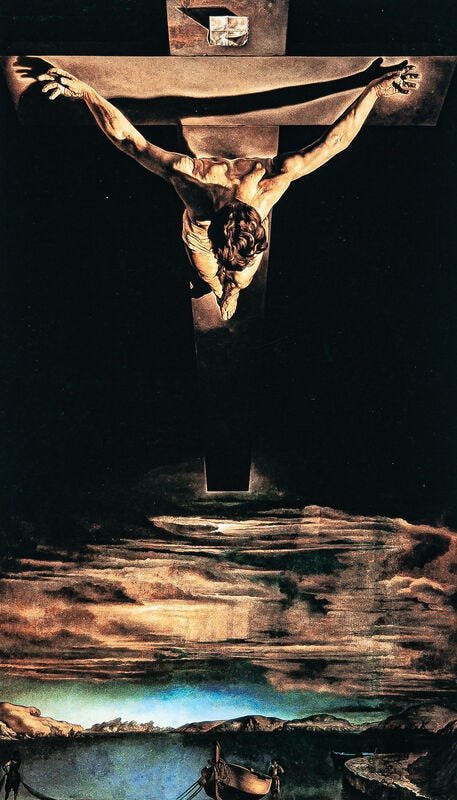
The success of this martyrdom was rooted in the fact that it was not a manufactured stunt. He did not engineer a political crisis to force his own demise, indeed he prayed to be spared (let this cup pass from me). And so whilst his death can be viewed as submission to a fate orchestrated by the state and the mob - the laying down of his life, through the manner in which he did so, remained as an active, willing gift to his friends, not as some passive victimhood. All while the machinery of the mob was allowed to unfold, he made sure that his love remained fiercely active. Because he did not author the violence that killed him, and because he accepted it with love when it was forced upon him, he remained an entirely innocent victim of his fate. This tension between passive submission and active love is what separates a true martyr from a tragic suicide.
The foundational relational intimacy between him and the apostles, and his obedient submission to fate, allowed for the trauma of the crucifixion to be absorbed by a network of real love. The shattering grief of the disciples became the engine transforming his death into the bedrock of a lasting community of billions. A community could be created from the violence because the sacrifice was made explicitly for them.
The Duped, Aaron Bushnell
Whipping forward to the digital age, the death of Aaron Bushnell - the American airforce engineer who set himself on fire outside of an Israeli embassy for the cause of Palestinian liberation - represents an inversion of Christ’s relational sacrifice.
To explain what happened with Bushnell, we must first introduce the French philosopher Jean-Pierre Dupuy’s exploration on the ‘modern sacred’ and ‘catastrophic panic’. In works like his The Mark of the Sacred, Dupuy diagnoses our contemporary era as one uniquely vulnerable to existential dread. He argues that historically, the sacred - along with its rituals, taboos, and communal sacrifices - functioned as a kind of container for our inherent capacity for self-destructive violence. Modernity or Post-Modernity, having systematically dismantled these ancient structures in the name of rationalism, has not freed itself from the terror that the rationalists ascribed to the belief in the divine, but instead has just lost the cultural architecture that is required to process it.
Consequently he argues that we now live in an era of “enlightened doomsaying”. To motivate ourselves to survive in a secular world devoid of supernatural safety nets, we fixate on the idea of apocalypse. From his For an Enlightened Catastrophism:
We must posit the catastrophe as a destiny that we can avert only if we project ourselves into the time following it, and look back at it as an event that has already taken place
Think climate change, the AI singularity, Malthusianism, nuclear Armageddon, engineered pandemic genocide, or massive meteorite strikes, and the hero tales that people tell themselves to prevent them. We have replaced one book describing the end of days with hundreds. Even within faith traditions, the religions that have moved the furthest from the idea of ritual seem to be the most vulnerable to theorising about the physical coming of the end of days. The current war in the middle east is motivated by apocalyptical thinking on both the sides of Israel and Iran, and protestant churches talk about eschatology and millenarianism to a far greater extent than do the Catholic or Orthodox. All live pinned beneath the crushing psychological weight of a future that feels violently predestined, terrified by the spectres of global collapse, ecological ruin, and endless war.
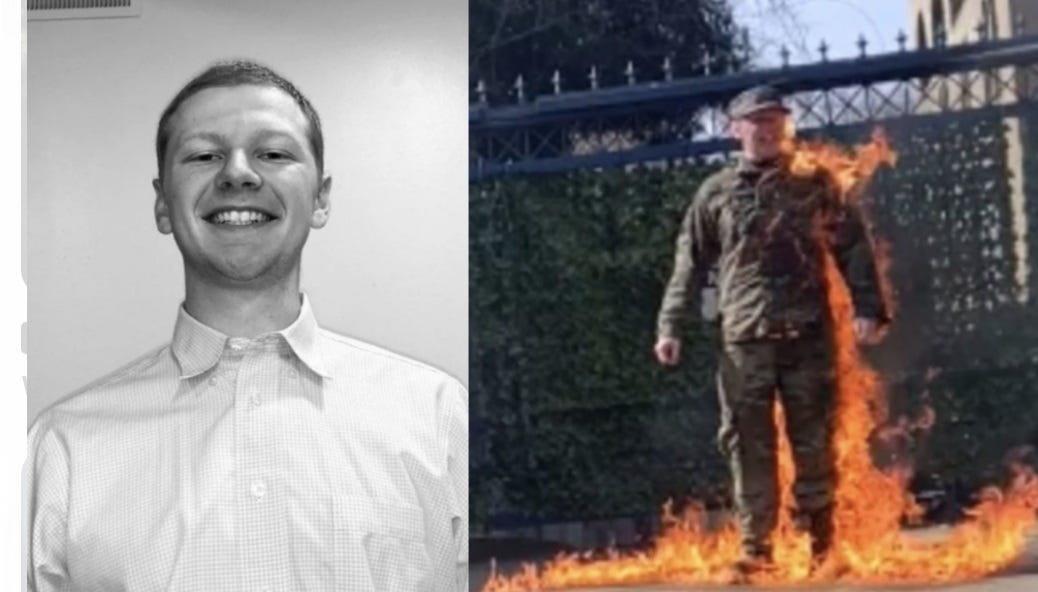
Bushnell was a victim of staring into this abyss. Personally religious, but committed to political anarchism instead of community, he lacked the local, flesh and blood anchorings needed to protect his mind. He absorbed the media and social media’s endless talking about the trauma of the Palestinian people without having the relational shelter that is necessary to bear it.
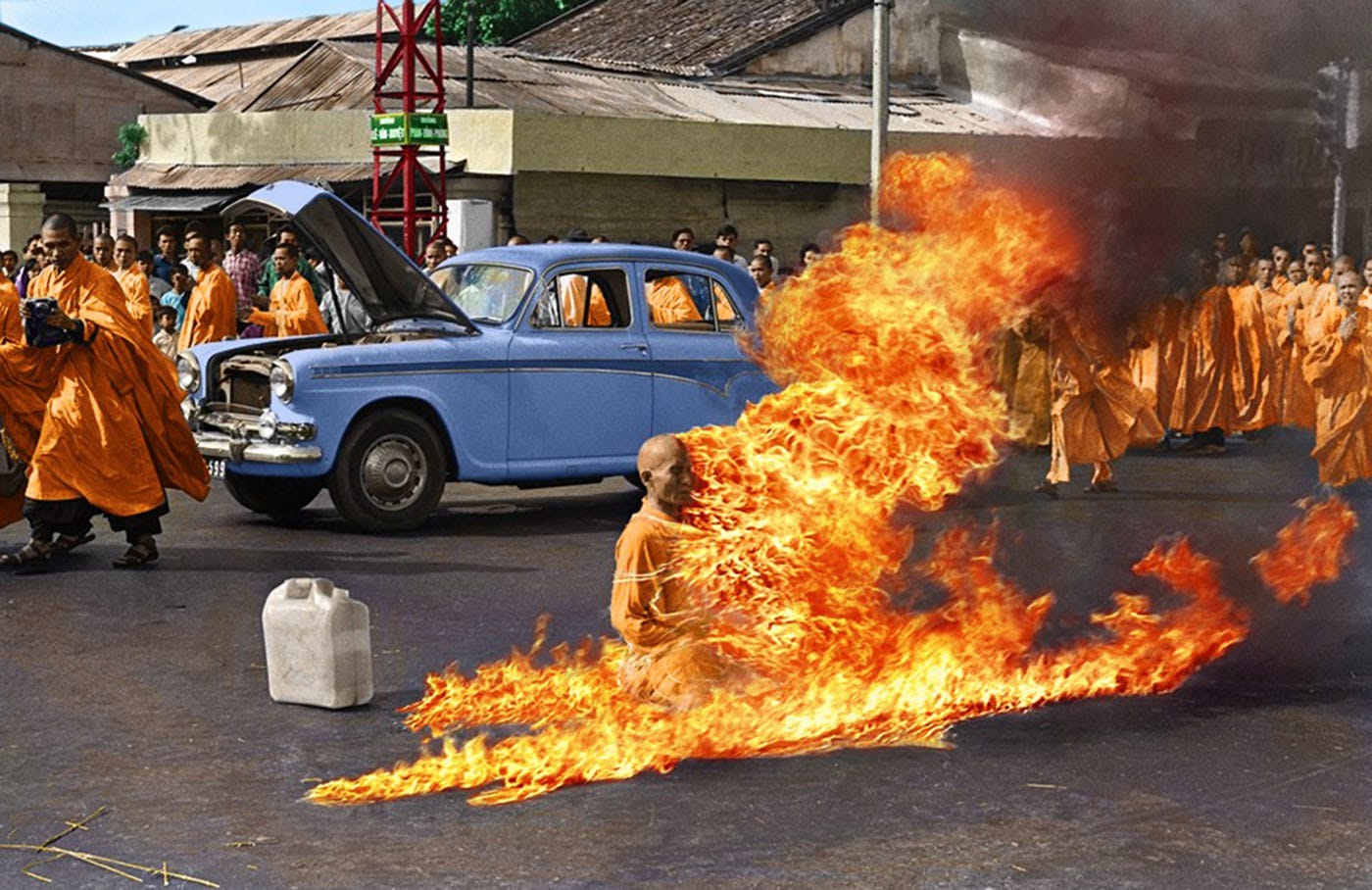
Furthermore, his death was extremely obviously a tragedy of mimetic illusion. He consciously imitated the self immolation of Thích Quảng Đức, the Vietnamese monk whose image went viral in 1963.
There is a widespread belief in the West that this horrific act was somehow important for the eventual end of the Vietnam war a decade later. That it took another ten years for the war to end suggests that this belief is somewhat questionable, but the belief exists anyway, because we so desperately want to tell the tale of meaning in death. Another dozen or so monks also burnt themselves alive in the aftermath of his immolation, but the images of their deaths have not been spread, and most of their names have not even been recorded. Their deaths attracted minimal media attention and exerted practically no impact on the war.
Bushnell was duped by this media constructed myth of historical catalyst. Convinced that extreme, solitary violence broadcast to the ether of the internet could serve as a mechanism for systemic change, he attempted a cursed form of Dupuy’s enlightened doomsaying - becoming a burning warning sign to try and awaken the masses. Like the Vietnamese monk, another man did try to kill himself in the same manner shortly after Bushnell’s death, and like in Vietnam, his name or image has not been released to the public. This copycat survived the suicide attempt and now lives on with his scars.
Bushnell, because he sacrificed himself to the impersonal digital void of Twitch.tv, instead of perhaps laying his life down for intimately known friends, did not build community or advance a cause with his death. A cause cannot weep for you. The internet cannot mourn. Bushnell died screaming, and his sacrifice was swallowed in a fleeting gaze of a panicked society that is devoid of the intimacy necessary to validate and carry forward a true martyrdom.
Mishima and the Archaic Sacred
If Bushnell represents a martyrdom of modern despair, then Yukio Mishima represents the martyrdom of anachronistic zeal. Possessing a soul suited to the samurai of ages past, Mishima longed for a transcendent, beautiful death.
Historical samurai were defined by their readiness to accept death at any moment, whether in battle or by their own blade, for their honour, and for their clan. Their deaths were the response to their shouldering of external duties within an established hierarchy. Mishima’s tragedy was that he just missed living in a society that had a place for such martial defence. Walking into his military medical exam in 1944 with a cold, a doctor decided he instead had tuberculosis, and declared him unfit for duty. Had it not been for this, he may have been able to die for Japan in alignment with his beliefs, perhaps even like the Kamikaze pilots that he would continue praising for the rest of his life. Robbed of his opportunity, he felt forced to meticulously engineer his own end.
Rene Girard, a friend and collaborator of Jean-Pierre Dupuy just mentioned, provides useful concepts for examining the failure of Mishima’s martyrdom, namely the ‘archaic sacred’, and ‘sacrificial crisis’. Girardian thought says that ancient societies maintained order and meaning by ritualised violence, that the killing of a scapegoat had real, if (at least) morally questionable, power to unify community. This ritual was conducted as part of a ‘sacrificial crisis’, a period of societal collapse, doubt or decay, where traditional boundaries or hierarchies are in peril. Crowds enter into a state of undifferentiation, where people’s innate mimetic rivalries and desires escalate until they serve to completely dominate their thoughts and actions, and the crowd acts as one.
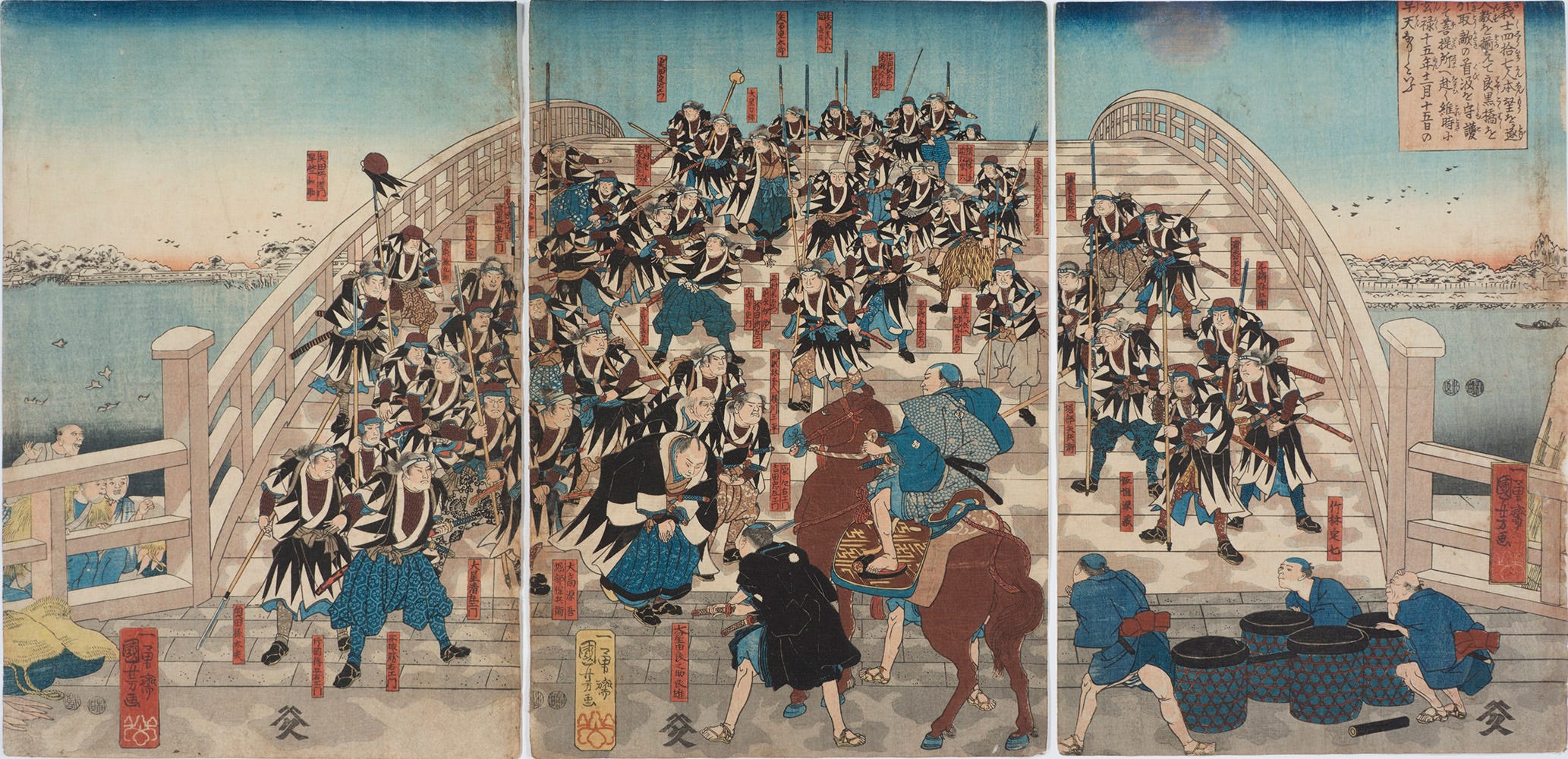
Take for example the tale of the Forty-Seven Ronin. A corrupt or greedy court official expected to receive bribes and gifts from the feudal lords that he was training in court etiquette. When he didn’t get what he wanted, he started to insult the lords, and one drew a dagger and attacked him in response to being insulted, beginning a cycle of escalation of mimetic rivalry/desire. Drawing his blade within the palace was against the law, and he was forced to commit seppuku as a result, leaving his 47 retainers leaderless and without livelihood. They planned revenge to satisfy their honour, but did not receive authorisation from the state to do so legally. Two years later the 47 acted anyway, and killed the court official as well as 16 of his men before turning themselves in. This tale of revenge quickly became rather popular, and the Shogun received many petitions for them to be pardoned for their crime of unsanctioned revenge, thereby questioning the authority of the laws of the shogunate. The state was now in the end-stage of ‘sacrificial crisis’, which only ritualised sacrifice could resolve, and so the Ronin were each “allowed” to commit seppuku. The ritual sacrifice resolved the crisis, and now instead of the illegal violent acts of the 47 questioning the legitimacy of the state, the tales told of their honour served to reinforce the state’s laws and moral codes.
For Mishima, westernised and materialistic post-war Japan had been entered into a state of catastrophic undifferentiation. The martial hierarchy of the samurai and the divine authority of the emperor had been replaced by the homogenising forces of capitalism and liberal democracy. As a devout believer in the old ways, Mishima believed in the power of ritualised violence to restore his beloved fallen order. Through his highly publicised seppuku, he hoped that his blood would arrest the cultural decay of Japan and restore its people to their true culture.
But there is a Girardian paradox here that dooms the enterprise. For the scapegoat mechanism to successfully restore the archaic sacred, the violence must be unanimous, and crucially, the mob must be blind to its mechanics. The 47 Ronin did not seek to strengthen the moral codes of Japan, they acted only on their desire for revenge. The crowd must genuinely believe that the victim is the true cause of the crisis, and that their elimination will magically restore peace.
Actively engineering your own death because you desire to be the scapegoat, entirely defeats the purpose. A self-appointed victim, openly orchestrating the sacrifice as an aesthetic protest, turns the ancient ritual into a self-conscious performance. By attempting to wield the scapegoat mechanism as a tool, Mishima exposed the machinery of the myth, and stripped it of its mythological power.
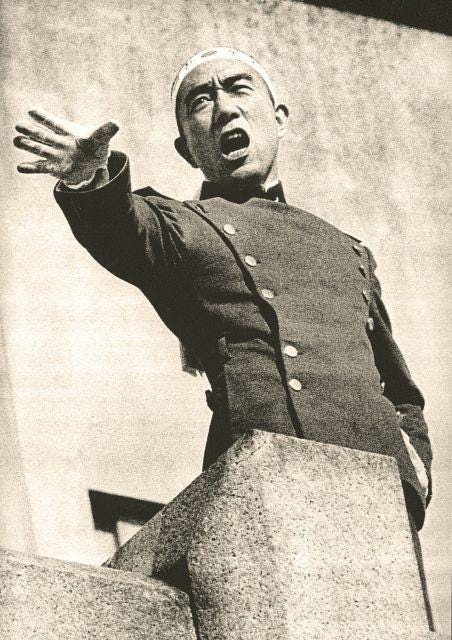
It is a disservice to Mishima to suggest he simply misunderstood his era, or overestimated the probability of the success of his act. He did not. He was acutely, painfully aware that the Japan of the age of samurai was dead, and that the societal altar upon which he was to bleed had already been dismantled by the modern age. He knew that what he was doing was, fundamentally, a simulacrum of what he felt drawn to. The real depth of his tragedy lies in the fact that he knew this, and performed it anyway. He executed the ritual hoping that, maybe, his unyielding will and the perfection of the act might momentarily be able to conjure the ghost of the archaic sacred, shocking his kin out of their undifferentiated stupor. But a simulacrum, no matter how flawlessly orchestrated, cannot resurrect what has already passed. His death became an isolated piece of violent theatre for a society that watched mostly in bewilderment, instead of in veneration and weeping reverence.
Between Spectacle and Communion
Mishima was a celebrated figure with a devoted following by the time he committed suicide, and so his death has served to inspire many, but the inspiration has been an aesthetic one, and it has not caused any societal, political or religious change. Bushnell’s sacrifice has been mostly forgotten, and when it is remembered, as it is in this piece, it is as a warning of how not to act. Conversely, Christ’s sacrifice, like many Christian martyrs after him, was received by weeping friends who intimately knew his heart, allowing his death to bloom into an enduring communion.
The necessity of the bonds of your beloved cannot be bypassed. You cannot martyr yourself for a concept, because concepts do not mourn. An ideology cannot carry the legacy of your broken body. It is only people that can shoulder the burden of a sacrifice, and we will only do so if the martyr’s life was first deeply entwined with our own.
This Easter, remember that you cannot hack the mechanics of martyrdom; and that there is no replacement for the foundation of interpersonal love.