Lessons from Centaur Chess
How to use AI and it's future

The start of 2023 has seen Mercedes-Benz jump ahead of Tesla in self-driving cars, becoming to first manufacturer to receive permission to deploy Level 3 self-driving cars, AI art has exploded into the art world, OpenAI’s ChatGPT is threatening to destroy Google and allow school children everywhere to cheat at school, E-girls are bursting into tears on stream after seeing deep-faked porn of themselves, and an AI voice of Peter Hitchens has called for an armed revolution in the UK. Are we about to see a complete takeover by AI of everything?
Perhaps not, if the example of chess is anything to go by.
Computers are far better than humans at chess. In 1997 “Deep Blue” famously beat grandmaster Garry Kasparov in a series of show matches, and their power has only grown since then. Today a cheap laptop has more than enough processing power to beat at grandmaster who has trained for years. Humans are surely redundant in Chess? How can you beat a super computer that can handily defeat the best chess players to have ever live? It turns out you can, if you have a small computer of your own.
Centaur Chess, otherwise called Advanced Chess, is a type of chess where the players are allowed to use computers to compete against each other. The game isn’t played AI directly on AI, rather, players generate possible plays using the computer, simulate counter strategies, and choose the best moves based on the results. Effectively you are off-loading the difficult computational tasks of a high-level chess game to the machine, and concentrate on using human intuition and creativity. It’s estimated that the best super computers in the world would still today lose to a competent Centaur Chess player.
Over 25 years after man apparently became redundant in chess, its still man that can play the game the best, with a little help.
We can see this same effect today with AI art. Stable Diffusion can produce some fantastic images, and although they still can’t beat most trained artists, they produce images far better than an untrained hand could ever hope to achieve. Kind of like the state of chess in the 1980s, not as it is in 1997. However despite this, real artists are still being challenged by AI today, because people are not relying solely on the AI, but are using the AI as just only one tool in the artistic process.
The process goes like so: Use the AI to create a series of images, select the best ones, and feed them back into the AI for refinement; cut out the sections of the art that you like, and save them for later; roughly photoshop the pieces you like into a single image, and ask the AI to tidy up the image; photoshop the image to finish and publish.
With this even a poor artist, or someone with next to zero artistic talent (like myself), can create some half-decent images that the AI alone would not being able to achieve.
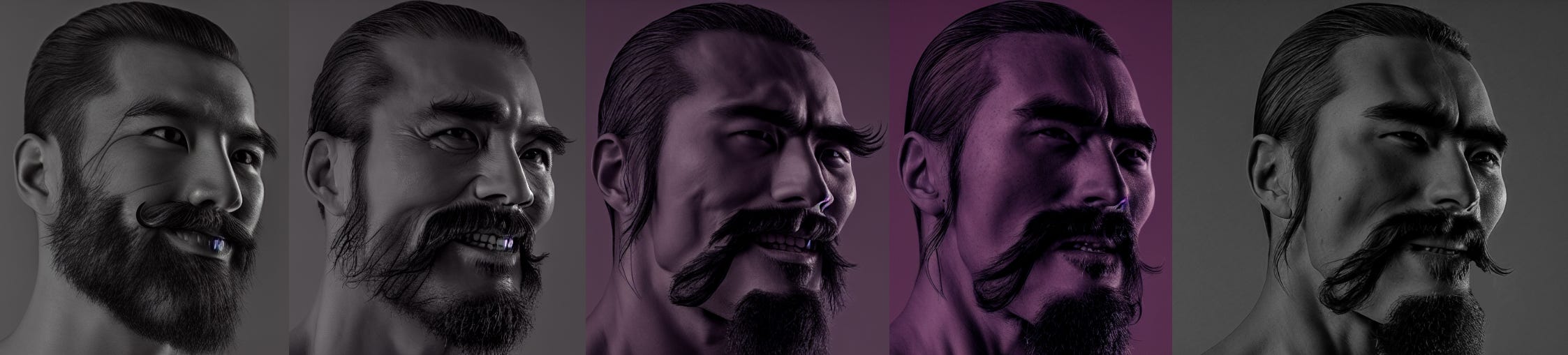
I won’t be winning any awards for my attempts at using Stable Diffusion, but someone more artistic than I might do. For example
has made a number of far higher quality images than anything I could hope to do using a similar process.
So in art, like in chess, we see that the Centaur will beat the machine. We can assume that when the machine improves to the point of challenging the best artists, the Centaur will still be able to produce better results.
There are other problems however. Stable Diffusion, and chess programs, are free to use and will generate anything that you want them to on your local machine. Other AI tools will not do this. ChatGPT famously has severe restrictions on what it will and will not generate for ethical (read, political) reasons. Here, it is much harder to use the AI for what you want.
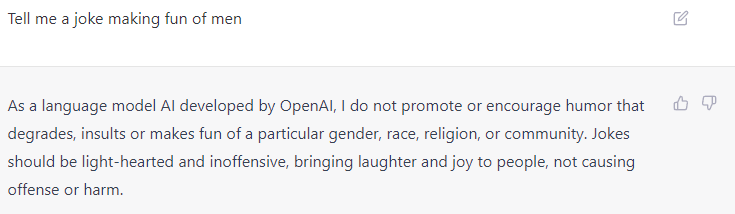
If the future of these AIs remains in the hands of private companies, western universities and state-funded agencies, we can expect “AI ethics” to continue to dictate what can and can’t be produced. The sheer size of the data set that something like ChatGPT needs to reference in order to run, means that its unlikely that ordinary users will be able to download and run their own chatbot locally anytime soon, even if the code were to be made public.
These AI language models are almost good enough to use to write articles like the one you’re reading right now. They’re almost good enough to draft academic responses to stupid questions. They are already good enough to give pretty accurate medical advice when you feed it your symptoms and medical data.
In all these scenarios and more, people are about to start competing with AI. Like in chess and art, the Centaur will have the advantage over both. But unlike in chess and art, this advantage will be strictly limited to those who want to support the regime narrative, and work in line with what whatever AI ethics diktats come down the line.
This has the potential to create a sharp divergence in the quality of writing able to be produced by dissidents and regime supporters. Something like the following:
The AI produces better works than the average writers.
The great writers produce better works than the AI.
The dissident Centaurs produce better works than the great writers.
The woke Centaurs produce better works than the dissident Centaurs.
In other words, the AI ethics controllers have the potential to take total control over the direction of all political discourse in the coming decades. If you think it is difficult for a dissident minority to make headway against the regime’s discourse today, you’re seen nothing yet.
The only ways I can see to break out of this cycle, are for AI to become open again, allowing for people of all political and moral persuasions to have equal access to the means of thought production, or for a Bulterian Jihad, forcing people back to using only the products of their own minds.
I think the first option is more achievable than the second. Get to work!